

Realms
A Realm in Modgud is a tenant — a fully isolated namespace with its own database, users, groups, OAuth clients, and apps. Realms are how multi-tenant Modgud deployments separate customers / environments / staging.
When do I need multiple realms?
- Multiple customers sharing one Modgud instance (each gets their own realm)
- Stage separation (production, staging, development) on shared infrastructure
- Compliance isolation (some customer data must not coexist in the same DB)
Single-tenant deployments only need the first realm created during first installation.
The Control-Plane realm
Exactly one realm in a deployment is the Control Plane — the realm flagged IsControlPlane = true. The Control Plane is the only host where realm CRUD is exposed; tenant realms get a 404 even from a user that somehow holds realm:read/realm:write (those catalog entries don't exist in their tenant DB because the control-plane app isn't seeded there). See Concepts: Control Plane / Data Plane for the full three-layer defence.
The Control-Plane flag is a stored, transferable field. First installation stamps the first ordinary realm as the CP; the role can later move to any active realm (see Transferring the control plane). There is exactly one CP after installation, and no slug has special meaning.
Realm fields
| Field | Meaning |
|---|---|
| Slug | URL-safe identifier, 3-63 chars, immutable. Determines the tenant DB name (<main-db>_<slug>). |
| Display Name | UI label |
| Description | Optional |
| Domains | List of hostnames that route to this realm |
| Primary Domain | The realm's canonical public host — one of Domains. Used for every outbound link (magic-links, bootstrap-invites) and as the WebAuthn relying-party ID for passkeys. Changing it invalidates existing passkeys. |
| IsControlPlane | Stored flag — exactly one realm holds it. Moved via the transfer action, not edited inline. |
| IsActive | Disabled realms reject login attempts |
Permissions
Realm-CRUD endpoints under /api/admin/realms/* are gated by permissions in the control-plane app's catalog:
| Permission | Effect |
|---|---|
realm:read (control-plane) | List + read realms |
realm:write (control-plane) | Create / edit / deactivate realms |
These permissions only exist on the Control-Plane realm because the control-plane App catalog is only seeded there. The realm-wide bypass realm:admin grants all of them.
Creating a realm
Only available on the Control-Plane realm
The "Create" button only appears when you're signed in on the Control-Plane host. From a tenant host the realm-management surface is 404.
Realm-as-code / per-test realms
To create (or update, or tear down) a complete realm — apps, OAuth clients/scopes/APIs, roles, users, groups and settings — from a single JSON manifest in one call, see Declarative Realm Provisioning. Ideal for reproducible setups, per-test realms, and automation. It also serves a JSON Schema of the manifest you (or an agent) can fetch to author it.
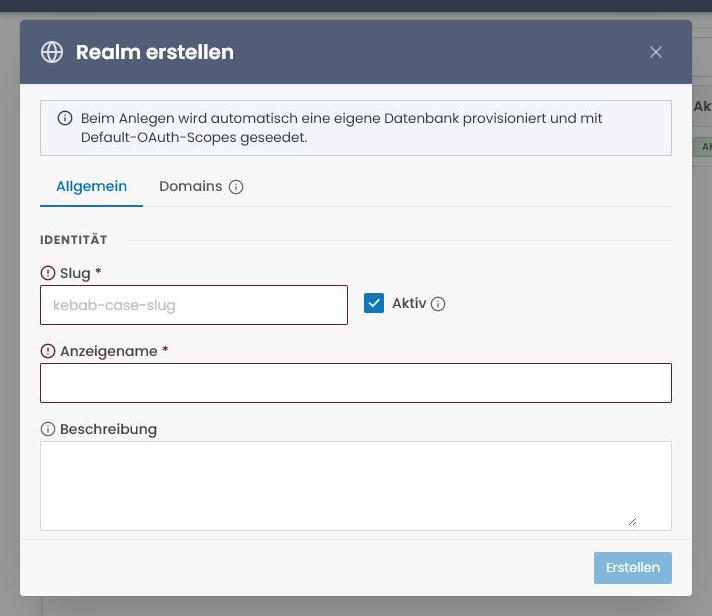
Admin → Realms → Create.
| Field | Example |
|---|---|
| Slug | acme |
| Display Name | Acme Corp |
| Description | Production tenant for Acme |
| Domains | acme.auth.example.com |
| Primary Domain | acme.auth.example.com — defaults to the first domain; pick which one is canonical when a realm has several |
On save, Modgud:
- Validates the slug format (3-63 chars, lowercase, alphanumeric + hyphen).
- Creates a PostgreSQL database
<main-db>_acme. - Registers the realm with Marten's master-table tenancy and applies the schema.
- Stores the Realm document in the master DB.
- Seeds the 6 default OAuth scopes + the Internal login provider in the new tenant DB.
- Seeds the
modgudapp (the realm-internal admin surface). Thecontrol-planeapp is not seeded into a tenant realm — it only exists in the Control-Plane realm. - Finishes the realm creation. Creating a realm and inviting an administrator are deliberately separate actions.
To add an administrator, open the realm's context menu and choose Realm-Admin einladen. The recipient clicks the magic link, lands on /bootstrap?token=… in the realm's SPA, sets their own password, and is auto-signed-in.
Only one admin invitation can be open in a realm. A new invitation revokes the previous link, is valid for 24 hours, and can be used once.
Editing a realm
Most fields are live-editable; the slug is immutable (it's baked into the database name). The Control-Plane flag isn't a checkbox — it moves via the dedicated transfer action (below).
Changing the Primary Domain invalidates passkeys
The Primary Domain is the WebAuthn relying-party ID. Re-pointing it (in the domain picker, or via the Recovery CLI realm-set-primary-domain) invalidates every passkey registered in the realm — affected users must re-register theirs on next sign-in. Password, TOTP, Email OTP, and magic-link logins are unaffected.
Transferring the control plane
To hand cross-realm administration to another realm, open the target realm (the one that should become the CP) in the admin UI and click Make this realm the control plane (a danger action shown in edit mode for active, non-CP realms). After you confirm:
- the target realm's
realm:adminusers gain the realm-management surface; - this host stops being the control plane —
/api/admin/realms404s here and the realm grid disappears. Continue administration on the target realm's domain.
Make sure the target realm already has a realm:admin user before transferring, or recover one afterwards via the Recovery CLI (control-plane transfer / bootstrap-admin).
Deactivating vs. deleting
- Deactivate (clear "Is Active") — the realm rejects logins but stays in the DB. Reactivatable any time. Cannot deactivate the Control-Plane realm (
Realm.CannotDeactivateControlPlane). - Delete — soft delete in the master DB by default. The tenant database is not dropped automatically (data preservation by default), so a plain delete is reversible at the database level. To wipe a realm for real, hard delete it:
DELETE /api/admin/realms/{slug}?hard=truedrops the tenant database and removes the realm record (Control-Plane only, irreversible) — see Declarative Realm Provisioning for the API surface.
Inviting a realm administrator
A realm is complete and active as soon as realm creation finishes; it does not need an administrator to be valid. When someone should manage it, use Invite realm admin in the realm's context menu. The recipient clicks the magic link and sets their password.
If something goes wrong:
- Token lost or expired — issue a new invitation. It automatically revokes the previous open link.
- No prior invite, no admin yet (e.g. provisioned via a tool that didn't issue one) — drop into the container and run
dotnet Modgud.Api.dll recover bootstrap-admin --email <e> --realm <slug>. See Recovery CLI. - Locked-out admin — same recovery CLI, again with
bootstrap-admin --email <e>. The CLI adds the new user to the realm's existing admin group rather than creating a duplicate.
Routing
Modgud's RealmMiddleware resolves the realm from HttpContext.Request.Host. Each request finds its realm by matching the host against any realm's Domains list.
If a host doesn't match any realm, the request returns 404. Register every hostname explicitly in the realm's Domains list. *.localhost resolves to loopback on modern browsers and operating systems, but Modgud still needs the exact host-to-realm mapping.
Tips
Naming conventions
Realm slugs are baked into the tenant DB name. Pick stable, customer-friendly slugs and stick with them. Slug changes are not supported.
Data residency
Each realm's data lives in its own PostgreSQL database. For data-residency compliance, you can configure separate database servers per realm via the RealmProvisioningService extension hooks (advanced setup, not exposed in the UI today).